How to Sell on Walmart Marketplace in 2026
For sellers, the barrier to entry is relatively low. Walmart charges no setup or monthly subscription fees, and eligible new sellers can access its 2026 New-Seller Savings program. After your store goes live, you must opt in through the Payments page in Seller Center to receive the discounts.
In this guide, we’ll cover how to start selling on Walmart Marketplace in 2026 and prepare your store for multichannel growth.
What You Need Before You Apply
-
A copy of a personal ID. Walmart requires identification for the applicant or legal business representative and may request additional identity verification during the review process.
-
A Business Tax ID or Business License Number. Social Security Numbers are not accepted. Your legal business information should match your official documentation.
-
Your business entity classification. Be prepared to identify the legal structure under which your business operates. For the U.S. Marketplace, Walmart does not accept nonprofit organizations, sole proprietorships outside India, or Hindu Undivided Family entities. Review Walmart’s current business eligibility requirements before applying.
-
Supporting documents that verify your business name and address.
-
A history of marketplace or ecommerce success. Walmart uses your existing selling history to evaluate whether your business is prepared to meet its customer-service and fulfillment expectations.
-
Products generally need a valid GTIN, UPC, ISBN, or EAN. Walmart verifies product identifiers through GS1 or the applicable issuing authority. Eligible products without an identifier may qualify for a UPC or GTIN exemption.
-
A catalog that complies with Walmart’s Prohibited Products Policy. Your listings should contain accurate product information, appropriate identifiers, clear images, and products you are legally authorized to sell.
-
Fulfillment through Walmart Fulfillment Services or a B2C U.S. warehouse with returns capability. If you fulfill orders yourself, your operation must be able to ship orders, process returns, and meet Walmart’s delivery requirements.
-
The ability to meet Walmart’s Seller Performance Standards. Walmart currently evaluates cancellation, on-time delivery, valid tracking, seller response, negative feedback, return, item-not-received, and late-shipment rates.
What You Can Sell and What Needs Approval
-
Books
-
Class II or restricted medical devices
-
Ingestible products
-
Fragrances
-
Topical products
-
Luxury brands
-
Software
-
Halloween and select seasonal products
-
Custom content
-
Jewelry, watches, precious gemstones
-
Currency, coins, and precious metals
For categories eligible for standard category approval, go to Health and compliance in Seller Center, find Category approval, and select Request approval. Some restricted categories, including certain medical devices and covered goods, use separate vetting processes. Review the applicable product policy before applying.
2026 Walmart Marketplace Fees at a Glance
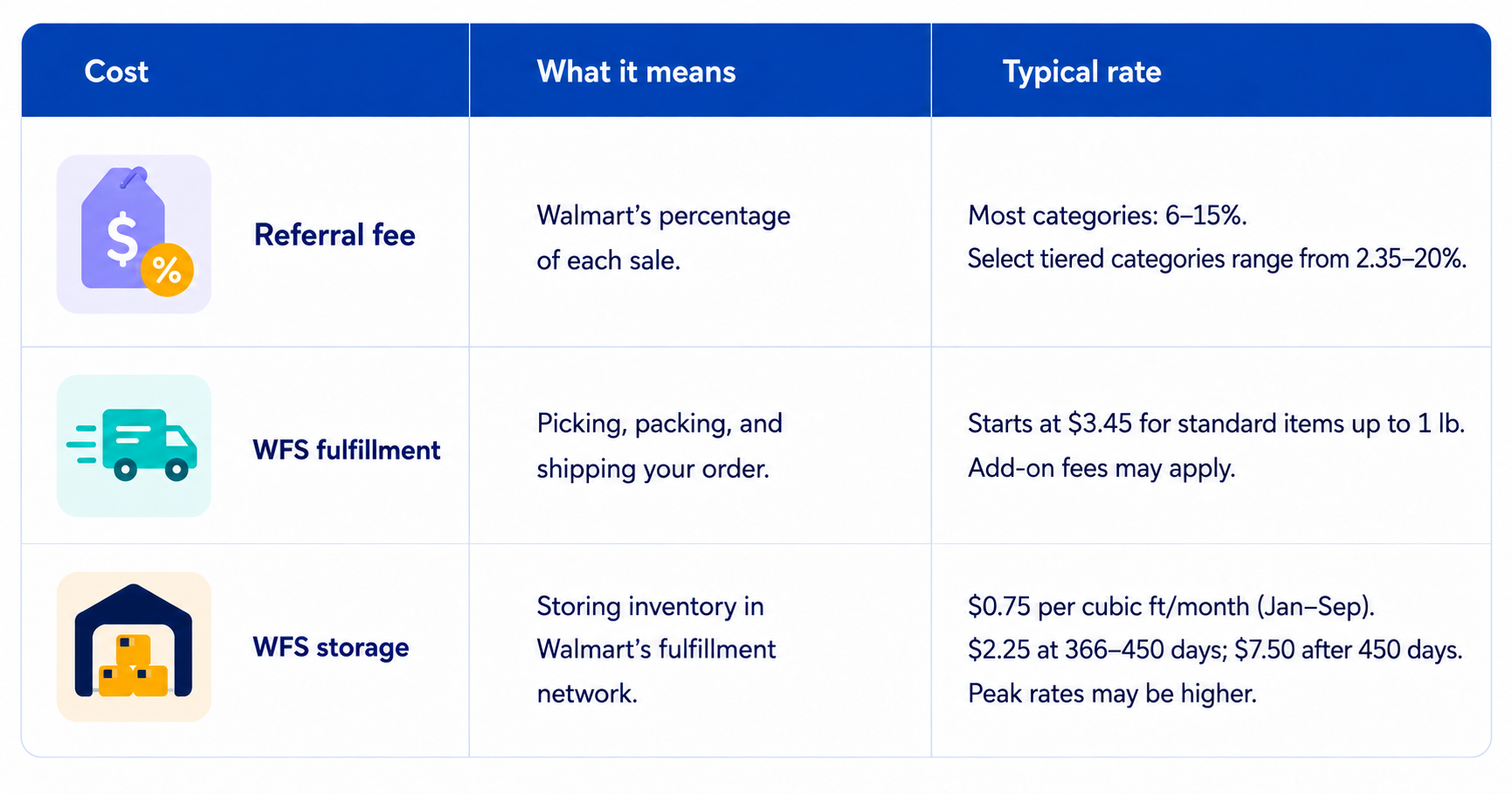
Walmart doesn't charge setup or monthly subscription fees. Instead, Walmart takes a percentage of each sale, called a referral fee. If you use Walmart Fulfillment Services (WFS), you'll also pay Walmart to store, pack, and ship your products.

A couple of things worth flagging before you price your catalog. Referral fees are tiered by category and, for many categories, by item price too. Check the Seller Center for your exact category rather than assuming a flat rate. And WFS storage fees escalate hard for slow-moving inventory, up to $7.50 per cubic foot for stock held over 450 days versus $0.75 normally, so it's worth watching anything that isn't turning over.
Eligible sellers who go live after February 1, 2026 may qualify for Walmart’s 2026 New-Seller Savings program. The program offers tiered referral-fee discounts of 20% on the first $50,000 in GMV, 30% between $50,000 and $500,000, and 40% above $500,000. Eligible sellers can also receive 10% off WFS fulfillment fees until they reach $2,000 in WFS savings. The promotion runs through January 31, 2027, and participation is subject to Walmart’s eligibility requirements and program terms. Review the 2026 New-Seller Savings details before calculating your expected costs.
Sources: Walmart Marketplace Referral Fee Schedule | WFS Fee Guide
Fulfillment Options: Seller-Fulfilled vs. WFS
After reviewing the costs above, the next decision is how you'll actually fulfill Walmart orders. Your choice affects more than shipping. It also determines where inventory is stored, who manages returns, and how easily your fulfillment setup can support additional sales channels later.
1 Who handles fulfillment +
2 Shipping speed +
3 Returns and customer support +
4 Cost +
5 Inventory control +
6 Best fit +
7 Multichannel potential +
Your fulfillment choice can also affect how you manage multiple sales channels. Whether you use your own warehouse, a 3PL, or WFS, you’ll need a way to keep inventory accurate and make sure orders reach the right fulfillment location.
As you add more channels, you’ll also need to manage product data, listings, inventory, and orders across platforms. A multichannel solution like UniCon can help keep these workflows connected as you grow.
The key is to choose a fulfillment setup that works for Walmart today and can support your multichannel operations later.
Think About Operations Early
As you plan your Walmart setup, it’s worth thinking beyond getting your first listings live. Three areas become harder to manage as your catalog and sales channels grow:
Inventory
Keep stock quantities accurate across channels to reduce overselling and stockouts.
Listings
Maintain product data, pricing, and marketplace-specific attributes without updating every channel separately.
Orders
Make sure orders from different marketplaces reach the right fulfillment location and can be tracked consistently.
You may be able to manage these manually at first, but the workflow becomes more complex as you add products, warehouses, or marketplaces. Planning how these areas will be managed early can save you from having to rebuild your process later.
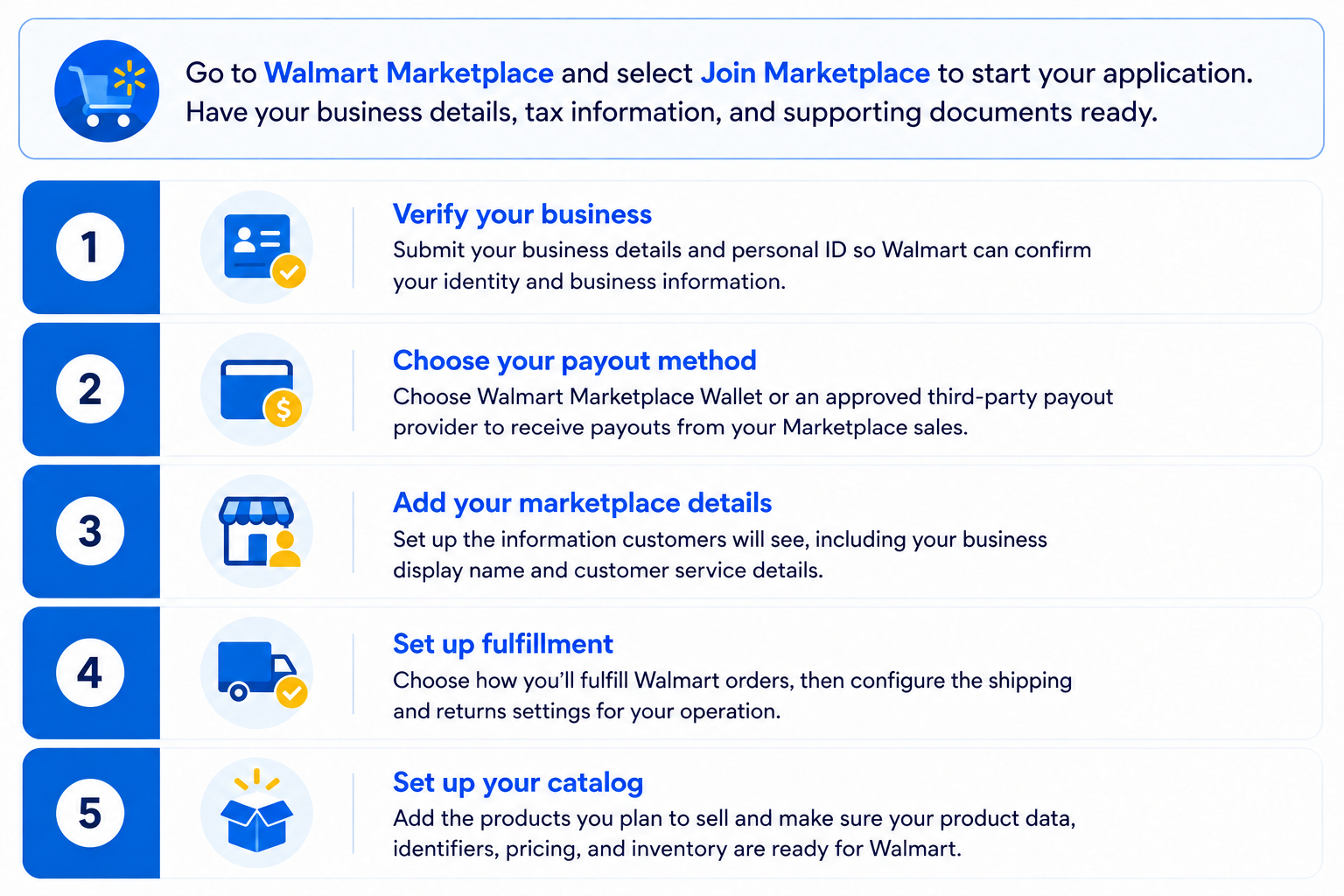
How to Apply and Set Up

Sources: Business verification and four-hour finalization: Complete Onboarding in Seller Center, Average ten-day onboarding: 2026 New-Seller Savings FAQ
Before You Publish Your Products
-
Use accurate product names, descriptions, and key features.
-
Add clear, high-quality product images that follow Walmart’s image guidelines and requirements. Main images should generally use a seamless white background.
-
Choose the correct category and complete the relevant product attributes.
-
Keep pricing competitive.
-
Confirm inventory and fulfillment information are accurate before publishing.